

Sunday, July 23, 2017

Saturday, June 17, 2017
Sweet Tasting No-sugar and Low-sugar Virginia-style Barbecue Sauces
 |
| No-sugar Shack Sauce, Low-sugar NOVA Sauce, Low-sugar Central-VA Sauce |
Nowadays, the most popular commercial barbecue sauces are extremely sweet often including high fructose corn syrup, honey, brown sugar and molasses. Many people have developed a taste for sweet barbecue sauces but due to dietary changes for losing weight or other health reasons, they have had to give them up. If you are one of those people, here are some suggestions for sweet barbecue sauce recipes that you might find suitable. One of these Virginia-style barbecue sauces is tangy rather than sweet and contains no sugar or sweeteners. The other two sauces are sweet, low-sugar or no-sugar variations of Virginia-style sauces.
The first sauce is my extremely popular Shackleford Pounds barbecue sauce, or "Shack sauce" for short. This barbecue sauce was inspired by a 19th-century Virginia barbecue cook named Shackleford Pounds who lived in Pittsylvania, Virginia. You can read about his amazing story in my book Virginia Barbecue: A History. It is in the southside Virginia-style of sauce and contains no sugar whatsoever. You can find the recipe by clicking here.
The second sauce is of the the Northern Virginia-style. It is a low-sugar alternative to the sweeter sauces found in that region of Virginia that also contain fruit.
Low-sugar NOVA Barbecue Sauce
1/2 Cup Shack Sauce
1/2 Cup Low Sugar Ketchup
3 Tablespoons No Sugar Added Peach or Apple Jelly
Splash of Worcestershire Sauce
Juice of 1/2 a Lemon
Stevia to taste (optional)
Add all ingredients to a saucepan except the lemon juice. Whisk while heating over low heat. Do not boil. Heat the sauce while whisking it long enough for the jelly to melt. When the jelly has melted into the sauce, remove from the heat. Add the lemon juice and mix well. If you use artificial sweeteners, optionally you can add Stevia (or your favorite artificial sweetener) to taste.
The third sauce is a low-sugar sauce similar to what you will find in central Virginia.
Low-sugar Central Virginia Barbecue Sauce
1/2 Cup Shack Sauce
1/2 Cup Walden Farms Balsamic Vinaigrette
1/4 Cup Low-sugar or No-sugar Ketchup (optional)
3 Tablespoons of Worcestershire Sauce
Juice of 1/2 a Lemon
Stevia to taste
Mix all ingredients well. Add Stevia (or your favorite artificial sweetener) to taste.
Tuesday, June 13, 2017
King's Barbecue in Petersburg, Virginia: 70 years of Virginia-Style BBQ
King's Barbecue in Petersburg, Virginia, is celebrating 70 years of Virginia-style barbecue excellence. Read more at WRIC's website here.
Sunday, June 11, 2017
Virginia Barbecue and the Big Green Egg - Match Made in Heaven

You can cook some mighty fine Virginia-style barbecue on a Big Green Egg. If you need recipes, browse the archives and pick up a copy of the book Virginia Barbecue: A History available at Amazon, Barnes & Noble and local booksellers.
Sunday, May 28, 2017
Memorial Day, 2017

“Your silent tents of green,
We deck with fragrant flowers;
Yours has the suffering been,
The memory shall be ours.”
By Henry Wadsworth Longfellow.
Tuesday, May 23, 2017
Goldie's Virginia Barbecue in Phoenix, Arizona
If you've read my book (You have read it haven't you? If not, get a copy and get started. You'll be glad you did), you know that people all over the country used to frequently cook and sell Virginia-style barbecue. Though not as widespread today, there are still a few places outside of Virginia that proudly serve Virginia-style barbecue.
Sauer's Barbecue Sauce is based on an old Virginia recipe. Bubba Lou’s Barbecue near Orlando, FL still sells Virginia-style barbecue and so does the Mason Dixon Line Restaurant in Washington state. There is even a Virginia-style barbecue recipe that is popular in the UK and another in Germany.
Here is an unfortunate account of Virginia-style barbecue in Arizona from the October 3, 1929 edition of the Arizona Republic under the headline "Fire Destroys Barbecue Shop on Opening Day."
In 1929, J. B. M. Goldsmith (Goldie) invested his savings of $500.00 to open a barbecue stand at 1154 East Washington Street in Phoenix, Arizona. $500.00 in 1929 would be about $7000.00 today. He not only invested his money, he invested his hard work and his expert knowledge of cooking barbecue.
On October 1, 1929, at 7:00 am, Goldie celebrated the grand opening of GOLDIE'S VIRGINIA BARBECUE. However, the day didn't go as Goldie had planned. By 1:30 pm, Goldie's barbecue stand was in ruins. In only a few hours, the entire operation burned to the ground due to defective wiring. The business was a total loss and Goldie carried no insurance.
I haven't been able to determine if Goldie persevered and reopened his restaurant, but I'm not through researching his story. Stay tuned.
Sauer's Barbecue Sauce is based on an old Virginia recipe. Bubba Lou’s Barbecue near Orlando, FL still sells Virginia-style barbecue and so does the Mason Dixon Line Restaurant in Washington state. There is even a Virginia-style barbecue recipe that is popular in the UK and another in Germany.
Here is an unfortunate account of Virginia-style barbecue in Arizona from the October 3, 1929 edition of the Arizona Republic under the headline "Fire Destroys Barbecue Shop on Opening Day."
In 1929, J. B. M. Goldsmith (Goldie) invested his savings of $500.00 to open a barbecue stand at 1154 East Washington Street in Phoenix, Arizona. $500.00 in 1929 would be about $7000.00 today. He not only invested his money, he invested his hard work and his expert knowledge of cooking barbecue.
On October 1, 1929, at 7:00 am, Goldie celebrated the grand opening of GOLDIE'S VIRGINIA BARBECUE. However, the day didn't go as Goldie had planned. By 1:30 pm, Goldie's barbecue stand was in ruins. In only a few hours, the entire operation burned to the ground due to defective wiring. The business was a total loss and Goldie carried no insurance.
I haven't been able to determine if Goldie persevered and reopened his restaurant, but I'm not through researching his story. Stay tuned.
Saturday, May 6, 2017
Charleston Barbecue - Southern Hospitality is its Secret Ingredient
 |
| Barbecued Pork Belly at Swig & Swine in Charleston |
Even though I had a very busy agenda during my most recent visit to Charleston, I was determined to visit as many barbecue restaurants there as I could. Fortunately, I was able to visit Bessinger's Bar-B-Q, Swig & Swine, Duke's Barbecue, Melvin's Ribs & Que, Home Team BBQ and Lewis Barbecue which included all but two of the places I had on my list.
Hogs are the animals of choice for barbecue in Charleston. You can find barbecued shoulders, ribs and pork belly as well as whole hog. The phrase "whole hog" means something a little different in Charleston than it does in most other parts of the South nowadays. In Charleston, barbecue restaurants literally serve the whole hog including heads, trotters and livers.
I have confessions from the pitmasters that they use those parts of the hog and suspicions that they may also use other parts such as the kidneys, lights and goozles. Parts of the hog that are not suitable for barbecuing are used to make South Carolina-style barbecue hash.
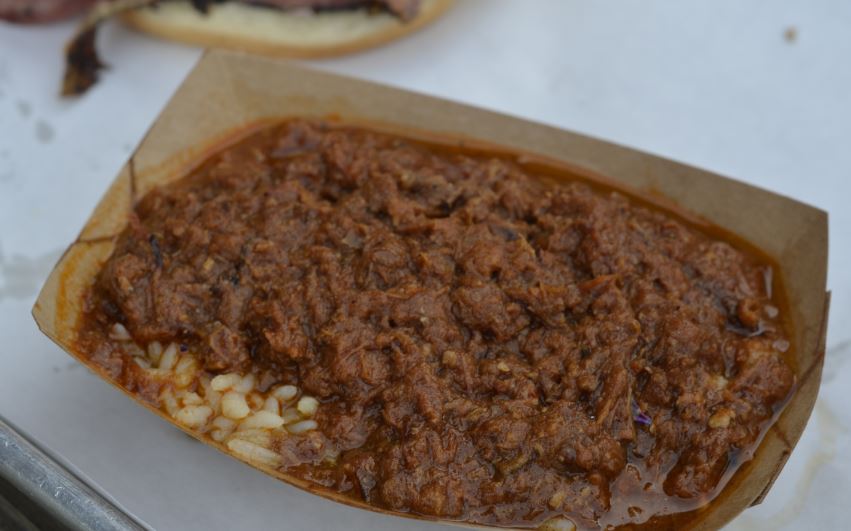 |
| BBQ Hash and Rice at Swig & Swine |
 |
| BBQ Hash & Rice at Duke's Barbecue |
Another distinguishing characteristic of Charleston-style barbecue is the sauce. Though all of the places I visited served a variety of sauces, some of which were not particularly South Carolinian, all of them except Lewis Barbecue (more about that later) serve a sweet and slightly tangy mustard based sauce.
 |
| Mustard based sauces at Duke's Barbecue |
 |
| BBQ Sauces at Home Team Barbecue |
The last barbecue restaurant I visited was Lewis Barbecue. The folks at Lewis Barbecue don't serve Charleston-style barbecue; they serve Texas-style barbecue.
 |
| Barbecue brisket & sausage at Lewis Barbecue |
Unfortunately for me, Rodney Scott's BBQ was one of those I missed. Scott's new Charleston restaurant opened the week after I had to depart for home. Of course, that means that I will have to visit again. Yep, it's a tough job but somebody's gotta do it.
Saturday, April 15, 2017
Virginia Barbecues Separated by 65 Years
 |
| Left - Illustration by Alexander R. Boteler from My Ride to the Barbecue: Or, Revolutionary Reminiscences of the Old Dominion published in 1860. Right - Virginia Barbecue circa 1920s. Holsinger Studio Collection. Courtesy of Special Collections, University of Virginia Library. |
On the left above is an illustration of a Virginia barbecue held in 1859. On the right is a photo of a Virginia barbecue held in the 1920s. Though separated by about 65 years and the Civil War, the similarities are striking.
Read all about it in Virginia Barbecue: A History now available in hardcover.

Wednesday, September 21, 2016
Delicious Tangy Virginia Brown BBQ Sauce Recipe - Southside Style
 |
| Tangy Virginia brown barbecue sauce drizzled on hickory smoked pork barbecue. |
It's tangy. It's savory. It's Virginia's own barbecue sauce that originated in Virginia's southside region. The recipe is in the book Virginia Barbecue: A History. The book is available online and at local booksellers.
Saturday, September 17, 2016

Wednesday, September 14, 2016
North Carolina Did Not Kidnap Barbecue from Virginia and no Theft was Committed
So, there are some articles on some news websites that make the sensational claim that I, the author of Virginia Barbecue: A History, make the case in that book that North Carolina kidnapped or stole barbecue from Virginia. One North Carolina newspaper even put the story in the crime section of their website. One paper asks, "Did North Carolina steal barbecue from Virginia?" Another newspaper writes, "'North Carolina kidnapped Virginia barbecue': Author asserts the delicacy started in the commonwealth."
First of all, let me make it perfectly clear. I do not argue, insinuate, imply or assert that North Carolina stole or kidnapped barbecue from Virginia in the book!
The misunderstanding is apparently based on a quote I used in the book from Nita Jones who wrote in the Richmond Times Dispatch in June of 1978:
"A quick survey of barbecue houses locally might convince you that 'North Carolina-style' barbecue has not only crossed the state line, but kidnapped the market as well."
So, let's set the record straight.
I did not make any claim, assertion, argument or insinuation that North Carolina stole or kidnapped barbecue from Virginia. Yes, southern barbecue was born in Virginia and eventually made its way into what is today North Carolina from there. However, that was simply a migration, not a crime. The word kidnapped was in the book from a quote made in 1978 about the proliferation of North Carolina-style barbecue restaurants popping up in Richmond, Virginia, at that time. The person who wrote the quote was simply making a point about the number of North Carolina-style barbecue restaurants that existed in Richmond in 1978. That's it.
And, as Paul Harvey used to say, that's the rest of the story.
You can purchase the book at online booksellers and local bookstores.

First of all, let me make it perfectly clear. I do not argue, insinuate, imply or assert that North Carolina stole or kidnapped barbecue from Virginia in the book!
The misunderstanding is apparently based on a quote I used in the book from Nita Jones who wrote in the Richmond Times Dispatch in June of 1978:
"A quick survey of barbecue houses locally might convince you that 'North Carolina-style' barbecue has not only crossed the state line, but kidnapped the market as well."
So, let's set the record straight.
I did not make any claim, assertion, argument or insinuation that North Carolina stole or kidnapped barbecue from Virginia. Yes, southern barbecue was born in Virginia and eventually made its way into what is today North Carolina from there. However, that was simply a migration, not a crime. The word kidnapped was in the book from a quote made in 1978 about the proliferation of North Carolina-style barbecue restaurants popping up in Richmond, Virginia, at that time. The person who wrote the quote was simply making a point about the number of North Carolina-style barbecue restaurants that existed in Richmond in 1978. That's it.
And, as Paul Harvey used to say, that's the rest of the story.
You can purchase the book at online booksellers and local bookstores.

Monday, September 12, 2016
Now Shipping! Brunswick Stew: A Virginia Tradition & Virginia Barbecue: A History

Brunswick Stew: A Virginia Tradition and Virginia Barbecue: A History available in stores and at online booksellers now!
Virginia Barbecue: A History
8 Chapters
Over 100 photos and illustrations
288 Pages
Over 750 primary and secondary sources cited
Over 70,000 words
Virginia-style barbecue has deep roots in history that go back to the earliest colonial times when it was first developed through a collaboration between colonists and Powhatan Indians. The Virginian style of barbecue eventually spread all over the south to become what we call today southern barbecue.
The basic barbecue cooking technique is ancient. American barbecue innovations are not. This book focuses on southern barbecue but also traces the origins of several other styles of American barbecue including California barbecue, backyard barbecue and kitchen barbecue.
Here is a sample of what's inside -
- There are four regional styles of real, authentic Virginia barbecue today.
- Read the story of the fateful Vauxhall Island barbecue in 1869.
- Read about the Virginia barbecue served in other states such as Missouri, Texas, North Carolina, Georgia, Pennsylvania, Arizona, Minnesota, Ohio.
- Read about the prominent 19th century American philologist James Trumbull who explained why the word barbecue is a "Virginian word."
- The word barbecue was used as a noun in English literature years before the Oxford English Dictionary claims.
- An English version of the word barbecue was used as a verb in English literature 13 years earlier than the Oxford English Dictionary claims.
- White barbecue sauce wasn't invented in Alabama. It's been around for hundreds of years.
- Read about the origin of southern barbecue's basic sauce of oil, vinegar, salt, black pepper and red pepper.
- Discover why the often repeated myth that barbecue was first cooked in the Caribbean and migrated to the North American colonies is wrong and unfounded.
- Find out why California barbecue is so different from southern barbecue.
- Read about when and why backyard barbecues became popular.
- America's first barbecue club was established in Virginia centuries before the KCBS.
- Virginians were the first to barbecue meats over hickory wood using the southern barbecue cooking technique.
- The first barbecue restaurant in the United States is found in Virginia about 100 years before the first recorded North Carolina barbecue restaurant.
- In the 1830s, two groves of trees were planted on the U.S. Capitol building's grounds to be used for holding barbecues. One grove for the Democrats and one grove for the Whigs. The "Barbecue Trees" (as they were called) remained on the Capitol grounds until the 1870s.
- Read about the 19th century Virginia barbecue cook named Black Hawk who was so accomplished at his craft that he had an audience with the President.
- Read about the African-American barbecue cook from Virginia who was a veteran of the Civil War but fought to save lives rather than take them.
Brunswick Stew: A Virginia Tradition
Drawing on historical and contemporary sources, author, award-winning barbecue cook and Brunswick stew expert Joe Haynes entertains with barbecue stew legend and lore, complete with recipes.
Seven Chapters, over 50 photos & illustrations, over 50,000 Words, over 475 primary & secondary source citations complete with authentic recipes and preparation techniques revealed.
Book Chapters
1. The Barbecue Stews
2. Virginia’s Food Traditions
3. Squirrel Soup
4. Barbecue Hash
5. Brunswick Stew
6. Burgoo
7. Recipes
Reviews -
"Joe Haynes adds to the scholarship of American barbecue with his remarkably well-researched book on Virginia barbecue. His work goes a long way toward putting the contributions of Virginia on the barbecue map.“
- Jim Shahin, Washington Post Barbecue Columnist
- Jim Shahin, Washington Post Barbecue Columnist
"I have been allowed sneak peaks into some portions of Joe Haynes' forthcoming book, and I assure you, if you love culinary history and barbecue, you will want this book!"
He clearly sees and helps tease out the contributions of ancient English foodways and their adaptations to and adoptions of those of Native America, as well as the role of enslaved Africans and African Americans who often were the true masters of the barbecue and stewpot. He follows traditions as they spread and evolved through the southward and westward expansion of the nation."
- Dr. L. Daniel Mouer, Chief Archaeologist, Professor of Anthropology and Archaeology at Virginia Commonwealth University, retired, founder and former Vice President of the Culinary Historians of Virginia
"Keep an eye out for Joseph Haynes book on Virginia Barbecue. Joe is an excellent historian when it comes to digging up truly remarkable BBQ related information that seems to have slipped by his contemporaries. He makes a strong case that shouldn't have to be made for the legitimacy of Virginia 'Q."
- Eric Devlin, Editor in Chief of Smoke Signals Magazine
"I've lived most of my life in Virginia, and for a while nearly a half-century ago, my work took me to the back roads near Surry, Va. There I found country barbecue places and smokehouses that were run by families that had been around most of the century. I visited many of these places and talked to their owners about their barbecue. What I found was clearly Virginia barbecue, done the old way as it had been since at least the civil war." "While I have no definite proof, what I learned then is consistent with what you're finding now. I think you're right."
- Wayne Rash, Freelance Writer and Editor
- Caroline Kettlewell, Virginia Living Magazine’s Smoke & Salt, October 2017
"If you like barbecue, then this is the book for you. If you don't like barbecue, but like history, then this is the book for you. If you are just interested in what barbecue is all about, then this is the book for you. Virginia Barbecue, A History, by native Virginian Joseph R. Haynes, is probably more of an encyclopedia of Virginia barbecue than a history."
- Wilford Kale, HRBooks contributor, The Daily Press
Sunday, September 11, 2016
Barbecue 101: Lesson #2
Good morning, Class! Here is today's Barbecue 101 lesson. There will be a test!

Subscribe to:
Posts (Atom)