Featured Post

Now Shipping! Brunswick Stew: A Virginia Tradition & Virginia Barbecue: A History

Brunswick Stew: A Virginia Tradition and Virginia Barbecue: A History  available in stores and at online booksellers now! Virginia B...

Showing posts with label Side Dishes. Show all posts

Sunday, September 28, 2014

Old School Virginia Brunswick Stew

,You know the stew is done when your paddle stands up in the pot.

Recently, I had the privilege of hanging out with the Proclamation Stew Crew as they cooked a "little" pot of Brunswick Stew. Lots of fun and delicious Brunswick stew to boot!

A close up look at the stew.

Time to eat!

Saturday, December 28, 2013

The Mystery of Virginia's Hot Potato

17th century Virginia Indian vegetables, no potatoes

In 1621, two years after being selected to be the first speaker of the Virginia House of Burgesses, John Pory was invited to a feast as the guest of king Ekeeks chief of the Onancock Indian tribe that lived in what is now Accomack, Virginia. He was fed, among other things, roasted oysters and "batata" (Spanish word for sweet potatoes). John didn't like the sweet potatoes because one burned his mouth as he bit into it without letting it first cool down to a safe temperature.

After that experience Pory reportedly said, "I would not give a farthing for a shipload." While sweet potatoes and potatoes are both "new world" foods, potatoes were first introduced in the colonies from a shipment to Virginia via Bermuda in 1621 rather than through trade with Indians, or so it has been thought. This is because no other Englishman mentions Virginia Indians eating potatoes or sweet potatoes in the early 17th century.

And, while we are discussing potatoes, let's discuss what we know first before we get into what we don't know. First, sweet potatoes are a completely different plant species than white potatoes. Sweet potatoes belong to the Convolvulaceae family which is known by its scientific name of Ipomoea batatas and also includes several varieties of morning glories that you may have growing in your flower garden. White potatoes, like Russets for example, are part of the Solanaceae family of plants belonging to the nightshade group. Yams are also another completely different species as well. Yams are monocots and are related to lilies and grasses and are native to Africa and Asia.

Potatoes and sweet potatoes were originally domesticated in the area of southern Peru and northwestern Bolivia around 7,000–10,000 years ago. Seventeenth century Spaniards would have referred to potatoes as "patata" and sweet potatoes as "batata". In fact, the English word "potato" is derived from "patata." You say patata I say batata, that's what it was all about in the 17th century. The Spanish probably got both first from the natives that lived in South and Central America and took them back to Europe with them in the 16th century.

So, how did sweet potatoes show up in 1621 on the table (figuratively speaking) of a Virginia Indian king and why were the Algonquin speaking Indians of Virginia using a non-Algonquin word? It's the mystery of Virginia's hot potato that needs to be solved!

On a side note, how potatoes arrived in Europe has never really been well understood. For over 200 years the "official" story was that potatoes were brought into Ireland by Sir Walter Raleigh who got them from Virginia. In fact, the Irish used to call them "Virginia potatoes." Again, this is doubtful as potatoes were not grown in Virginia in the 16th century as far as anyone can tell. Some now believe that Sir Frances Drake picked up potatoes while sailing around the coast of South America before picking up colonists from Roanoke Island around 1585 and brought them back to Ireland.

Muddying the waters more is the fact that in 1600, John Pory translated, edited, and published A Geographical Historie of Afirca, written in Arabicke and Italian by John Leo, a More, borne in Granada and brought up in Barbarie. In that work, Pory translated a passage and used the word "batata" saying it was from the West Indies. "They have good sustenance also by meanes of a root, called there Igname, but in the west Indies Batata." While the original author (or even Pory) could have been confusing yams with sweet potatoes just like we do today, the fact remains that the word "batata" was not unknown to Pory in 1621. Yet, he, supposedly, speaks of it in 1621 as though it was the first encounter he had with it. So, the questions around this event include:

1.) Is King Ekeeks' "batata" really sweet potato?

2.) Is John Pory relating a truthful account of the feast or did he embellish it?

3.) If "batata" is sweet potato, why didn't the other Englishmen like Smith, Clayton, Spelman, and Strachey mention them as they actually lived with Virginia Indians in the 17th century?

4.) Did king Ekeeks serve some other root or tuber that is native to Virginia and called it "batata" because he had learned the word from other European explorers and wanted to impress Pory?

5.) Did Pory misunderstand an Algonquin word that sounds like "batata"?

If Pory's account is accurate, and the "batata" he mentioned is in fact sweet potatoes, in all likelihood the Onancock Indians traded for them from the Spanish when they visited Virginia in the late 16th century and, for some reason, they didn't share them with other Indians in Virginia.

That is the story of Virginia's hot potato mystery. For some reason, it makes me hungry for sweet potato casserole.

Sunday, December 8, 2013

The Origin of Brunswick Stew - An Authentic 19th Century Recipe

Old Virginia Brunswick Stew

“We crossed the stream upon a shaking plank laid from bank to bank, and strolled down the slope to the scene of operations. An immense kettle was swung over a fire of logs that were so many living coals. The smell of Brunswick stew had been wafted to us while we leaned on the fence. A young man, who had the reputation of being an epicure, to the best of his knowledge and ability, superintended the manufacture of the famous delicacy. “Two dozen chickens went into it!” he assured us. “They wanted to make me think it couldn’t be made without green corn and fresh tomatoes. I knew a trick worth two of that. I have worked it before with dried tomatoes and dried sweet corn soaked overnight.” He smacked his lips and winked fatuously.”

This brief account of an 1844 barbecue held in Richmond, Virginia describes a scene that was typical of such events in the nineteenth century. Smoke lingering in the tops of trees, the enticing aroma of roasting meat in the air and the large kettle of simmering “barbecue stew” was a scene repeated over and over again all across the American South. The phrase “barbecue stew” refers not to a stew made of barbecued meats. Rather, it is a stew that was (and still is) traditionally cooked and served along with barbecue and it differs from region to region.

For the rest of the article and the recipe, navigate over to the Smoke Signals Barbecue Magazine site and check out the latest issue 13. In it I discuss the origins of Brunswick Stew, the modern Brunswick Stew rivalry between Virginia and Georgia, and the recipe for an authentic, 19th century Virginia Brunswick stew.

Sunday, November 24, 2013

The Three Sisters that Saved Jamestown


Potomac Salad


When the English arrived at Virginia in 1607, they found a vast wilderness inhabited by Native Americans who had lived in the land of Tsenacomoco (the Native American name for the tidewater region of Virginia; a.k.a. the coastal plain that is east of the fall line) for centuries. The English arrived thinking that they could thrive in the "new world" by replicating English towns and English farms growing English foods. After the Starving Time of 1609 - 1610 where most of them died of starvation and disease, they realized just how wrong they were. Under the leadership of John Smith, the English began to learn that the key to survival in the "new world" was to adopt the ways of the native people that were thriving. That meant that the English would have to learn the ways of the "salvages."


http://www.virtualjamestown.org/images/artifacts/jamestown.html
A Patawomeck Pot traded to an English
Colonist. Analysis shows that a maize and
venison stew was the last food cooked in
it before it was discarded by the
colonist after his "Indian" meal.
Over the first three decades of English settlement in Virginia, the efforts of the Powhatan Indians saved the English colonists from death and starvation. The Patawomeck Tribe that established villages along the Potomac river in Virginia were particularly key to English survival. Many accounts of the early English colonists tell of the corn (maize), beans, and squash the Patawomecks supplied to the English saving them from starvation.


http://www.usmint.gov/mint_programs/nativeamerican/?action=NADesign
The 2009 United States Native American
$1 Coin Depicting a Native American
Woman Tending to a Milpa.
Today, the three crops of maize, beans, and squash are known as the three sisters. The Native Americans of the Southwest called their fields of maize, beans, and squash "milpas." Scientists have since learned that those three important foods grown together in the same garden complement each other; each providing benefits helpful to the other two. In the estimation of H. Garrison Wilkes, a maize researcher at the University of Massachusetts in Boston, the milpa “is one of the most successful human inventions ever created.” Corn provided a natural pole for the bean vines to climb. Beans trapped nitrogen on their roots thus improving the overall fertility of the soil by providing nitrogen for next year's corn. The bean vines also helped stabilize the corn plants making them less vulnerable to blowing over in the wind. Shallow-rooted squash vines served the same purpose as mulch shading emerging weeds and preventing soil moisture from evaporating which improved the overall crop's chances of survival. The Patawomeck method of inter-planting corn, beans and squash in the same mounds is still a sophisticated and sustainable system for small gardens that provides long-term soil fertility and a healthy diet. And, today, corn (maize) is the most important crop in the world.

This Thanksgiving, take a look at your table. There is still much Patawomeck and Powhatan Indian influence at work even today. The turkey, corn (maize), beans, squash and pumpkin and North American varieties of nuts were all foods that the Natives of Tsenacomoco taught the English to hunt, grow, cook, and enjoy. There is no question that the three sisters saved Jamestown from disaster. And, the importance of those three foods are seen today more than ever.

To celebrate Thanksgiving this year, I decided to create a dish that, I think, captures the food preferences of both the English and the Natives of the 17th century. I call it "Potomac Salad." It is a dish with Patawomeck Native American ingredients seasoned with ingredients like the English would have used.

Potomac Salad

1 medium sized butternut squash
1 15.5 ounce can of kidney beans, rinsed
1 15.5 ounce can corn, drained
Bacon Fat, warmed until liquefied
Apple Cider Vinegar (ACV)
1 Tsp Dijon Mustard
1/2 medium sized red onion cut into thin strips
Salt & Pepper to taste
Pinch of ground cayenne pepper (optional; but I have strong reason to believe the English colonists in 17th century Virginia would have used it often instead of black pepper)

Peel and cut the squash into about 1" cubes. Reserve the seeds. Toss the squash with salt and pepper and a little bacon fat (Virginia smoked pork). Toss the seeds with a little bacon fat too. Roast the squash and seeds in a 350 F degree oven turning them once or twice until done. The seeds should be done in about 15 - 20 minutes. The squash should be done in about 30 minutes.

Make a vinaigrette using 4 TBS of bacon fat, 4 TBS of ACV, the mustard, salt, pepper, and cayenne. Add the corn, beans, roasted squash, onion, and vinaigrette to a skillet and heat over medium heat until hot. Use the seeds as garnish and serve as a side or by itself over mixed greens.

Friday, June 22, 2012

Jerked and Grilled Veggies


Here is a great recipe for grilling vegetables. I cooked these to go with some pork chops that I was grilling but they are so good I thing they would be great with beef or chicken and even by themselves. Here is how I made the dish.

I cut some bell peppers, Anaheim peppers, and onions into little square like shapes about the size of a U.S. quarter. I also sliced some mushrooms and tomatoes. I cut some fresh pineapple into chunks. I put them in a large bowl and poured over a little olive oil. I used just enough to give all the pieces of the vegetables a light coat of the oil after tossing them in it. Then, I sprinkled on a generous amount of dry jerk seasoning and mixed well. I put the veggies in the fridge and let them marinate for about 2 hours.

I fired up my grill and got a really hot bed of coals going. I grilled the veggies long enough for them to get a nice bit of browning and "grill" marks. Then, I put them in an aluminum pan and sealed it up well with foil. You could use a plastic container with a lid, a bowl wrapped with foil, or even a zip lock, food safe plastic bag. I then let them steam from the temperature of their own heat while I grilled up the chops.

The vegetables come out tender and tasty!

Monday, April 2, 2012

Grilled Brussels Sprouts

Grilled Brussels Sprouts
So, you don't like Brussels sprouts? I know of several people who never liked them either until they tried cooking them on the grill. Besides being tasty, Brussels sprouts are nutritious too. They are a good source of vitamins K and C and are also a good source of dietary fiber, folate, vitamin A, manganese, potassium and vitamin B6, tryptophan (an essential amino acid), thiamin, iron, phosphorus, protein, magnesium, riboflavin, vitamin E, omega-3 fatty acids, copper and calcium. They are like the multivitamen of the vegetable world. So, get cooking!

You will need:

A pound to a pound and a half of Fresh Brussels Sprouts
3 tablespoons of Olive Oil
3/4 teaspoon of sea salt
1/2 teaspoon of black pepper
Juice of half a lemon
Grill/smoker setup for 325F using indirect heat

1.) Wash the Brussels sprouts. Trim off any of the outer leaves and brown stems that you don't like too.
2.) Toss the Brussels Sprouts in the olive oil, lemon juice, salt and pepper.
3.) Put them in the grill and close the lid.
4.) Let them cook for 35 to 45 minutes until they are tender on the inside.

Sunday, March 18, 2012

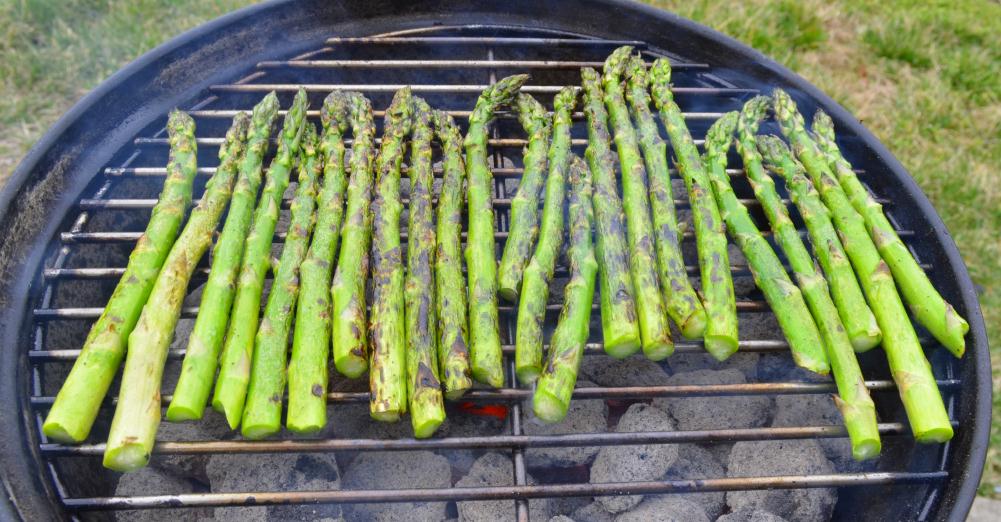
Grilled Asparagus


Asparagus (Asparagus officinalis according to our scientist friends) was first grown 2500 years ago in ancient Greece. It is a member of the lily family and is related to onions, leeks, and garlic. Asparagus is very nutritious too. It's high in glutathione, which is an important anticarcinogen, and it's a good source of folic acid, vitamins A, C and E, B-complex vitamins, potassium and zinc. It also contains rutin, which protects small blood vessels from rupturing and may protect against radiation. In fact, Asparagus has been used to treat problems involving inflammation, such as arthritis and rheumatism. Today, about 80 percent of all the asparagus grown in the United States comes from California.

One other great thing about asparagus is that it is delicious grilled! Here's how to do it. You will need:

Asparagus
Olive Oil
Salt & Pepper
A hot grill setup for direct grilling
A spritzer bottle with water in it (A refillable spray bottle)

1.) Toss the asparagus in olive oil and season with salt & pepper. Let it hang out in the refrigerator until the grill is ready.

2.)  Fire up your grill. You want it setup for direct heat.

3.) Place the asparagus on the grill perpendicular to the grill grates. This prevents the asparagus spears from falling through the grates.


4.) Let the asparagus cook until it begins to brown (caramelize) on the outside. When it begins to brown, give it about a 1/4 turn. Repeat the turning until it is uniformly browned on all sides.

5.) If the oil on the asparagus causes the grill to flare up, give the fire a little spritz of water to cool it down a little.

6.) When the asparagus is caramelized on all sides, it's ready to remove from the grill and serve.


7.) Enjoy!

Thursday, February 9, 2012

Picnic Fries

Picnic Fries

Nothing goes better with a good hamburger or pulled pork BBQ than a side of french fries. By the same token, nothing can ruin a good hamburger or good pulled pork BBQ worse than a side of bad french fries. It's a simple concept; good fries are delicious and bad fries are just horrendously bad.

It's easy to cook bad french fries, I guess. You just slice some potatoes or buy some already sliced up for you from the freezer section of your grocer, put them in some hot fat and cook them until they turn brown. Yes, that is easy. But, to cook perfect french fries takes a labor of love. It doesn't happen by accident and it does take some trial and error.

To me, bad fries fall into three basic categories: greasy flimsy, chip crunchy, and crunchy hollow. The greasy flimsy fries are the ones that have no crunch and are usually greasy. They are kind of like little grease sponges that have absorbed ample quantities of fat that causes them to droop under their own weight. Chip crunchy fries are more like thick potato chips. They look good on the outside but when you bite into one of them it's dry and crunchy all the way through. The crunchy hollow fries are the worst of the worst. You pick up a crispy fry thinking that it is going to be really good, you bite it and it shatters between your teeth because all of the potato on the inside has been cooked out of it.

To me, perfect french fries are not greasy. They are deliciously crispy on the outside and have a pillow of fluffy potato goodness on the inside. And, most importantly, they stay crunchy the whole time I am eating my meal. I guess you could say that I want my french fries to have everything. I want them to be light and fluffy on the inside and crispy on the outside even after they have cooled down and are cold.

I cooked a lot of potatoes in my journey to produce my perfect french fries. The recipe and method I list here is the closest I have come to cooking them. This recipe yields a delightfully crispy fry on the outside and a fluffy inside of potato goodness. And, the best part is, they stay crispy and light even after they turn cold. To me, they would be the perfect fries to take on a picnic. They hold up that well. But, they are so tasty while hot it will be very hard to make a batch last long enough to cool down. Now, on to the recipe.

You will need russet potatoes, cold water, apple cider vinegar, canola oil (or your favorite deep frying oil), and kosher salt. Start by peeling the potatoes and slice them into about 1/4" square strips. It's important to make sure the strips are as uniformly sized as possible as this helps to ensure they all cook evenly. If you have a french fry slicer, all the better.

Once the potatoes are peeled, rinsed, and sliced, submerge them in cold water mixed with apple cider vinegar. The proportion of vinegar I use is 2 TBS of vinegar to 3 cups of water. Make sure you have enough of the water/vinegar mixture to cover the potato strips. Let the potatoes soak in the water/vinegar mixture for 30 minutes. I have let the potatoes soak longer but I don't think it brings anything to the party to do so.

About 10 minutes before the potatoes will finish soaking start to bring a pot of water to a boil and add 1 teaspoon of salt for every 4 cups of water you are boiling. When the potatoes have soaked for 30 minutes put them in the boiling water, wait for the water to start boiling again and boil them for exactly 10 minutes. Now would be a good time to start bringing the oil in your fryer up to 325 degrees F.

After 10 minutes of boiling, remove the potato strips from the boiling water and let them dry on paper towels. At this stage you can refrigerate the fries to be deep fried later or just go straight to the deep fryer AFTER YOU DRY THEM WELL. You don't ever want to put water in your hot deep fryer. That's very dangerous.

Now, you will need to double fry the potatoes. Fry them for about 3 to 4 minutes at 325 degrees F. You don't want them to start to brown at this stage. Remove them from the oil and let them drain on a rack. Bring the oil up to about 360 to 375 degrees F and fry the potatoes again until they reach a medium brown color. You can experiment with the color to find what you prefer.

When the fries are done, place them on a rack to drain and sprinkle them with kosher salt to taste and enjoy. And, if you have the will power, let some hang out and cool down and give them a try. You will be surprised how delicious and crispy they remain even after they are cold.

Crispy outside, fluffy inside even after they cool down.

By the way, the Sweet & Smokey Dipping Sauce shown in the photo goes perfectly with these fries. Click here for the recipe.

On a side note, "French fried" potatoes in Virginia go back much further than what we are generally told. The story goes that the recipe for french fries was brought back to America by soldiers who fought in France and Belgium in WWI.

However, in The Virginia House-Wife By Mary Randolph published in 1836, Mrs. Randolph gives us a recipe "To Fry Sliced Potatoes" where she tells us to peel potatoes, slice them about 1/4" thick, and fry them in lard or dripping" (hello duck fat) and to "keep them moving until crisp; take them up and lay them to drain on a sieve; send them up with very little salt sprinkled on them."

I think Mrs. Randolph would approve of my picnic fries.

Deep frying food can be dangerous. Please observe all precautions.